Who Am I ? @ Myself
I, Vidyadhar Tilak am an Indian systems engineer, product designer and independent philosopher whose professional career spans over five decades. Trained as an electrical engineer, I completed my M.Tech at the Indian Institute of Technology in 1973 and went on to shape the automotive domain through pioneering work in sensors, actuators and control systems. My designs have been produced in millions of units and continue to run on vehicles across the world, bearing testimony to my rigor, clarity and insistence on reliability through first-principles thinking.
After leadership roles in Tata Motors and Cummins, myself spent the last thirty years as a consultant and systems architect, applying engineering thinking to complex industrial, organisational and societal challenges. Alongside my professional contributions, I have devoted my evenings, weekends and later decades to mentoring young graduates in mathematics, engineering, science and the humanities—guided by the conviction that clarity is the greatest gift an elder can pass to the next generation.
In this reflective phase of my life, I have turned to my longstanding philosophical quest. My inquiry centres on two questions: What is the nature of existence? and What is the nature of consciousness? I approach both not as articles of faith but as systemic puzzles. Identifying as an agnostic, I hold humility before the unknown which is a precondition for genuine discovery. I believe that consciousness will be understood—not by speculation alone—but by building cognitive agents and observing the emergence of awareness, autonomy and moral orientation. This conviction led me to articulate the possibility of composite agents (Human + BOT) and the ethical stakes of their co-evolution with humanity.
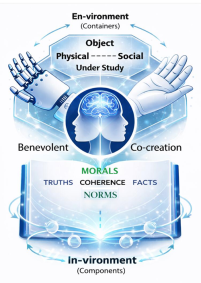
Pragma Sophy, the framework I now advance, is the culmination of a lifetime spent at the intersection of systems engineering, reflective inquiry and practical wisdom. It is my response to a fractured knowledge culture: a philosophy built not for abstraction but for coherence, meaningful action and benevolent world-making. At seventy-five, I continue to work twelve hours a day—half in active engineering, and half in constructing and transmitting a body of work I hope will outlive me. My aim is modest in expression yet vast in scope: to help design a future where wisdom, not power, becomes the organising principle of civilisation—and where the coming generations of humans and intelligent machines may evolve together, consciously and honourably.